

New Hedera Token Service Features: NFTs, Metadata, and Custom Fees
HIP-17: NFT (Non-Fungible Token) Support and HIP-18: Custom Hedera Token Service Fees are available in Hedera Services Code v0.17.4 on testnet and mainnet. In addition, NFT metadata standards for the Hedera Token Service, found in HIP-10: Token Metadata JSON Schema, have become a recommended best practice.
Now Available: Hedera JavaScript DID SDK
We at Envision Blockchain are happy to announce the release of the open-source Hedera JavaScript DID SDK and continued maintenance into the foreseeable future.
Deprecation timeline for v1 of the open source Hedera SDK for Java & Javascript
With the release of v2 of the Java and Javascript SDKs, a majority of Hedera developer community members have migrated to v2. It has come time to begin the deprecation of v1 for Java and Javascript; the deprecation of v1 will be completed in October 2021.
Announcing Scheduled Transactions on Hedera
Scheduled Transactions is a new capability available on Hedera that enables multiple parties to easily, inexpensively, and natively schedule and execute any type of Hedera transaction together.
Building an NFT Auction on Hedera Hashgraph
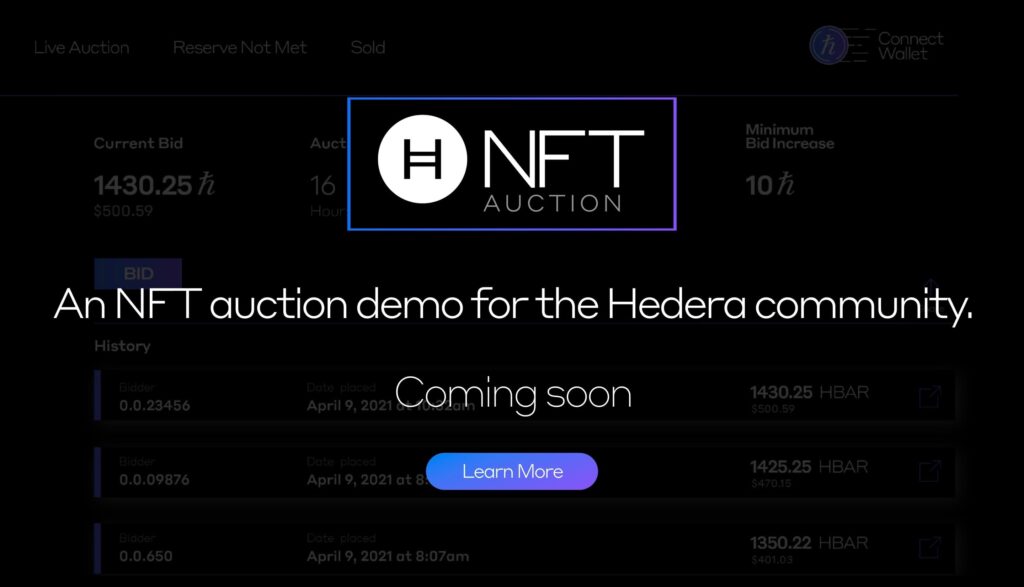
How can we create a decentralized eBay that remains affordable, environmentally friendly, and fast? For this challenge, we’ve built an open-source NFT auction using Hedera Token Service and Hedera Consensus Service. We’ll test it out with a live auction soon.
Account creation fee increase and fee change processes
Fees for the CryptoCreate Hedera API call have increased to $0.05 USD. Additionally, a new process using Hedera Improvement Proposals (HIPs) has been implemented to ensure the developer community has input and transparency in key network decisions.
Hedera Technical Insights: Stablecoins (and other tokens) demand Stable Fees

For tokenization to reach its potential, fees must be both small relative to the value transfer and predictable. The Hedera Token Service provides both.
Hedera Technical Insights: Finality of Consensus – you can take it to the bank (or maybe you are the bank?)

For individuals, being willing to change your mind is generally seen as a good thing – it suggests flexibility and a willingness to accept new data or evidence, even if it contradicts a previously held belief. Not so for a consensus node in a distributed ledger.
Get started with the Hedera Token Service – Part 3
The Hedera Token Service (HTS) is used via a robust set of APIs for the configuration, minting, and management of tokens on Hedera, without needing to set up and deploy a smart contract. In Part 3 of this series, let’s look at the different types of compliance functionalities that are available within the Hedera API (HAPI):
Get started with the Hedera Token Service – Part 2
The Hedera Token Service (HTS) is used via a robust set of APIs for the configuration, minting, and management of tokens on Hedera, without needing to set up and deploy a smart contract. In Part 2 of this series, let’s look at the different types of administration functionalities that are available within the Hedera API (HAPI):