

Multi-Game Economies
Gamers spend on average 14.8 hours per week gaming, with many going even further beyond that—to the point of it becoming a second job. What if this hobby could become profitable for the average gamer? Previous articles covered the subjects of HCS-based game records and its possible use cases. This third article synthesizes these concepts into a new subject: multi-game economies.
HashConnect Part 1 – Secure Signing for dApps Built on Hedera
HashConnect is an open source library that is developed by the HashPack team. This library enables decentralized applications (dApps) to connect to a user’s wallet and send transactions for them to sign and submit to the Hedera network nodes.
Meet Venin, a concise yet powerful SDK alternative for JS Devs
To build dApps, one has the raw power of the official SDK at their disposal; but what if that’s sometimes too much? What if there was a more human-centric way of writing code similar to other mature, well-known tools in this space of Smart Contract development? Tools such as the likes of ethers, hardhat or ganache, to name but a few? Well now you can! Succinct, bold and expressive; programming on Hedera has never been this easy!
Smart contract rent is coming to Hedera
All Hedera entities will require renewal fees. Solidity smart contracts are the first. Get to know the lifecycle of entities and your options to design self-sustaining Solidity smart contracts.
Use Cases for HCS-Based Records in Play-to-Earn/NFT Gaming
“Play-to-Earn” gaming has grown to a $3 Billion dollar market in less than a year, and investors are taking notice. The era of play-to-earn gaming has begun, presenting an exciting new frontier for game development – as well as several potential pitfalls. All the risks associated with decentralized finance are also present in play-to-earn, namely smart contract exploits. But the Hedera Consensus Service (HCS) offers a solution to these inherent problems.
Unblocking and unloading: The speed secrets behind Hedera Smart Contracts 2.0

The Smart Contracts 2.0 service utilizes the Hyperledger Besu EVM. As part of the preparation a number of performance optimizations were contributed by Hedera to the Hyperleger codebase. Hedera’s implementation is completely open-source but developers of the service have received questions around the specific optimizations implemented and we wanted to summarize what’s been improved.
How to Get Event Information from Hedera Smart Contracts

Events in Solidity provide a way to log things and actions that take place in your smart contracts. In this article, you will learn how to get human-readable event information from contract logs using transaction records and mirror nodes.
Hedera Hashgraph Announces Mainnet Launch of EVM-Compatible Smart Contracts 2.0
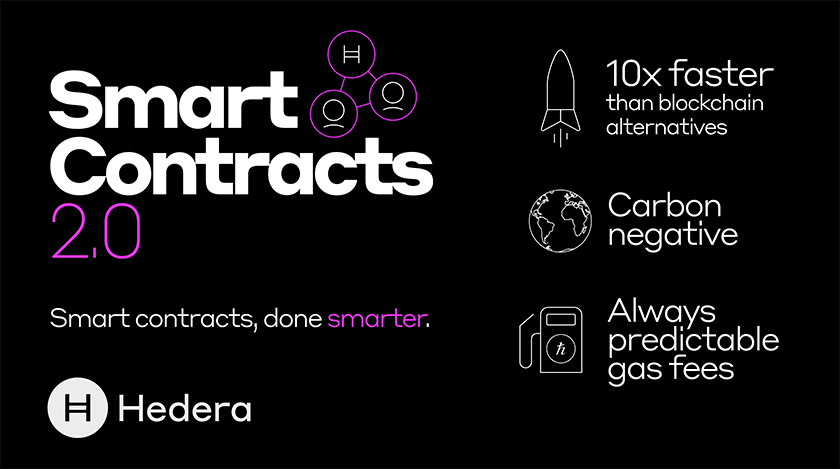
Dallas, TX – Feb 3, 2022 – Hedera Hashgraph, the most used, sustainable, enterprise-grade public network for the decentralized economy, today announced a significant upgrade through the mainnet launch of the Hedera Smart Contracts 2.0.
How to Deploy Smart Contracts on Hedera – Part 1: A Simple Getter and Setter Contract
The Hedera Smart Contract Service enables you to build decentralized applications and protocols that scale with Solidity smart contracts. Recent updates to this service include Ethereum Virtual Machine (EVM) upgrades, database architecture modifications, and support for Hedera Token Service. Whether you’re new to smart contract development or migrating from another smart contract platform, use Hedera to develop and deploy fast, low-cost, and carbon-negative smart contracts. In this article you will learn how to write a getter-setter smart contract in Solidity and deploy it on the Hedera network.
Introduction to Solidity smart contracts

Solidity is the world’s most popular way to write smart contracts. Hedera Smart Contracts 2.0 is a more scalable way to run smart contracts on the Hedera network. Understand the basics of Solidity and the Ethereum Virtual Machine.